
A non-surgical approach to heart health, improved circulation, and total body wellness—available at Care Nashville in Brentwood, TN.
"For thousands of years, the idea of 'flow' has been revered and recognized as central to life. It is a common denominator of most medical philosophies, treatments and doctrines around the world."
— Page 33
Blood flow, energy force, and life force are inextricable concepts. Blood flow is the most fundamental element in good health.
It Is the Source of Life.EECP is a non-invasive, FDA-cleared circulation therapy designed to enhance cardiovascular function, cognitive clarity, and overall stronger physical performance. We call it Flow Therapy. FDA approved in 1995.
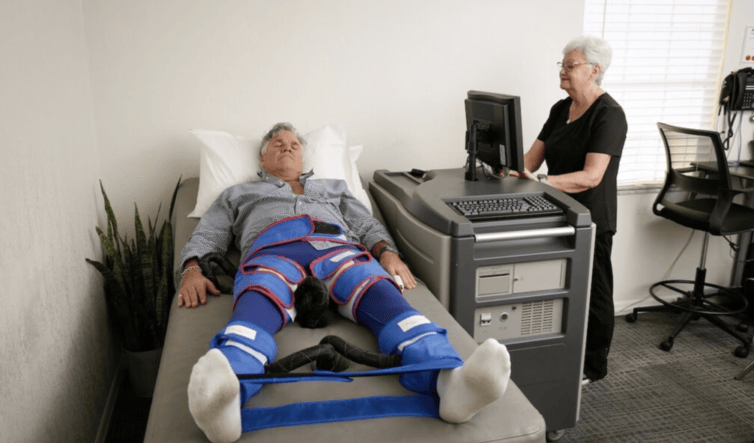
During an EECP session, blood pressure-type compression cuffs are placed on the legs and hips. These cuffs inflate and deflate in precise synchronization with the heart's natural rhythm, monitored continuously via ECG.
During the heart's resting phase (diastole), the cuffs inflate in rapid sequence from the calves upward, creating a wave of pressure that augments blood flow to the coronary arteries and creates new vessel pathways. During the active phase (systole), the cuffs rapidly deflate—reducing the resistance the heart must work against.
This repeated process encourages development of natural collateral circulation pathways—sometimes described as the body's own bypass system.
The results are astounding. The cuffs squeeze and release in sync with the patient's heartbeat, promoting blood flow throughout the body—particularly to the heart.
Blood pressure-type cuffs secured around the legs and hips.
Heart rhythm continuously monitored to synchronize cuff inflation with each heartbeat cycle.
During diastole, cuffs inflate upward—augmenting blood flow to the coronary arteries.
Cuffs deflate immediately before systole, reducing the heart's workload.
Repeated sessions create new vessel pathways—the body's own natural bypass system.
There are more than 100 published articles and studies on EECP in major medical journals—all documenting its staggeringly high rate of effectiveness across a wide range of conditions.
Heart disease is the leading cause of death in the US. EECP is a powerful tool in treating systemic heart disease—it strengthens circulation noninvasively and without risk.
Page 90Over 100 published studies document EECP's high rate of effectiveness in reducing or eliminating angina, chest pain, shortness of breath, fatigue, and nitroglycerin use.
Page 18Circulation is greatly improved as new vessels develop and older vessels experience improved flow. Patients often notice results throughout the entire body.
Frequently due to lack of blood flow to the tiny nerves responsible for sensation. EECP stimulates more blood flow to affected nerves, improving function and reducing symptoms.
Page 108Blood flow is thought to play a key role in RLS. A study of 6 patients showed that after 35 sessions, restless leg symptoms improved by 80 percent.
Page 109Most commonly a result of reduced blood flow. In a Dresden, Germany study, men reported significant improvement in penile rigidity and erectile function after just 20 sessions.
Page 104EECP Flow Therapy increases blood flow to the brain. Patients recover faster and more completely. It is even helpful for patients who suffered a stroke years earlier.
Page 100Clarity of thought and detail retention improve as a byproduct of EECP Flow Therapy, as blood flow is increased to the brain.
Blood flow helps determine the body's ability to use sugar. When increased blood flow reaches the pancreas, insulin production is enhanced, improving overall blood sugar control.
Page 106Lack of blood flow to the dopamine-producing part of the brain is a major factor. Patients report reductions in tremor, improved balance, improved walking, and better facial expressions.
Page 103EECP Flow Therapy improves blood flow to the eyes, especially the retina—benefiting patients whose vision impairment is linked to atherosclerosis of the ophthalmic arteries.
Page 102EECP normalizes endothelial cell function, reduces vessel stiffness, and raises Nitric Oxide levels—with Nitric Oxide increasing by 60% during treatment and remaining 20% elevated one month after.
Page 52Increased shear stress of blood flow on vessels can mimic the anti-inflammatory effect of powerful medications. EECP also markedly reduces Angiotensin II—a key vasoconstrictor.
Pages 50–52SLE patients face very high risk for heart disease and stroke. EECP's non-invasive approach makes it the best method to treat heart disease in this complicated, high-risk group.
Page 95RA patients have disproportionately high rates of heart disease and are at much higher risk for invasive procedures. EECP also improves blood flow to affected joints—reducing joint pain and aiding mobility.
Pages 96–98EECP passively increases blood flow just as vigorous exercise would. Improved blood flow improves both energy levels and activity tolerance.
Fibromyalgia is characterized by widespread pain, chronic fatigue, and impaired circulation. EECP's ability to improve blood flow, reduce systemic inflammation, and increase oxygen delivery to muscles and tissues may support reduced pain and improved energy in fibromyalgia patients.
Also considered for: Patients seeking non-surgical alternatives to cardiac stents, and patients who are not candidates for invasive procedures. A consultation with the Care Nashville clinical team is required to determine individual candidacy.
While EECP is a physical treatment, it also has proven antioxidant effects. Malondialdehyde is a substance created when cell membranes are damaged by oxidative stress. Vitamin E, a potent antioxidant, decreases malondialdehyde levels through chemical reaction.
EECP causes a steady decrease in malondialdehyde levels by improving blood flow and removing this toxic metabolic by-product from cells—indicating an antioxidant effect similar to that of Vitamin E. These antioxidant effects are among the biochemical changes that help explain the long-term benefits of EECP treatment.
Page 115The following case studies are drawn from Heal Your Heart with EECP by Dr. Debra Braverman. Results are individual and not guaranteed.
Treatment of Clinically Diagnosed Alzheimer's Disease by External Counterpulsation: A Randomized Clinical Trial
This 12-month multicenter, blinded, randomized, sham-controlled trial enrolled 190 patients with early Alzheimer's disease or Mild Cognitive Impairment (MCI). Patients receiving full-pressure EECP showed significant improvements in both cognitive function (VADAS-cog, p=0.005) and daily living activities (ADCS-ADL, p=0.036) compared to the sham group. Critically, these benefits persisted through the full 12-month assessment—six months after treatment had ended—with no serious device-related adverse events reported. The study concluded that EECP "significantly improved cognition and ADL compared to sham treatment in early AD" and represents a promising novel approach for this otherwise devastating disease.
DOI: 10.1177/15333175261451918 — SAGE JournalsExternal Counterpulsation on Performance in Patients with Mild Cognitive Impairment or Mild Alzheimer's Disease: A Randomized Sham-Controlled Study
This randomized, single-blind, sham-controlled trial across 10 clinical sites enrolled 190 individuals with MCI or mild Alzheimer's disease. EECP-treated patients improved significantly on cognitive assessment scores versus the sham group, with the greatest benefit seen in patients who also had Type 2 diabetes (average 14.6-point improvement, p<0.005). Neuroimaging showed substantially less decline in blood flow to the left hippocampus—a region critical to memory—in the EECP group compared to sham at 12 weeks. The study authors concluded that treating vascular blood flow is a viable therapeutic target for MCI and Alzheimer's disease.
JACC Vol. 81, Issue 8 — American College of CardiologyEnhanced External Counterpulsation Efficacy on Exercise Endurance in COPD Patients and Healthy Subjects: A Pilot Randomized Clinical Trial
This pilot randomized controlled trial enrolled 72 volunteers—including healthy adults, individuals with low exercise endurance, and patients with COPD. All subgroups receiving EECP showed significant improvements in multiple measures of exercise endurance and oxygen uptake compared to the non-EECP group (all p<0.05). No adverse events were reported. The study concluded that EECP can meaningfully improve cardiopulmonary fitness across different populations—not just those with heart disease—making it a promising non-invasive intervention for broader respiratory and physical conditioning applications.
DOI: 10.2147/COPD.S225566 — Dove Medical PressA Case Report: Enhanced External Counterpulsation Successfully Treated Lower Extremity Lymphedema
This case report documents the first successful use of EECP to treat lower extremity lymphedema—a chronic, progressive condition the WHO classifies as the second most common cause of disability worldwide. A 43-year-old patient with post-surgical lymphedema following cervical cancer treatment underwent 18 EECP sessions. Standard medications had failed to produce results. Following EECP, the patient's lower extremity circumference reduced by approximately 9 cm with no adverse events. The authors propose that EECP's sequential compression mechanism—which mimics the muscle pump effect—promotes lymphatic return, reduces fibrotic tissue, and may offer a novel non-invasive approach for mild-to-moderate lymphedema.
⚠ Preprint — This study has not yet completed formal peer review. Results should be considered preliminary.
DOI: 10.21203/rs.3.rs-7947397/v1 — Research SquareEnhanced External Counterpulsation, Focusing on Its Effect on Kidney Function, and Utilization in Patients with Kidney Diseases: A Systematic Review
This systematic review examined the existing body of research on EECP's effects on kidney function and its potential application in patients with kidney disease. The review explored EECP's hemodynamic mechanisms—particularly its ability to augment renal blood flow and reduce cardiac workload—and assessed how these effects may benefit patients with compromised kidney function who are at elevated cardiovascular risk.
PMC10602636 — PubMed CentralExpert Consensus on the Clinical Application of Enhanced External Counterpulsation in Elderly People (2019)
This expert consensus document—developed by leading clinicians specializing in EECP and geriatric care—establishes clinical guidelines for the safe and effective application of EECP specifically in elderly patients. It addresses age-related cardiovascular changes, appropriate patient selection criteria, treatment parameters, and safety considerations unique to older populations. The consensus affirms EECP's strong benefit-to-risk profile for elderly patients across a range of cardiovascular and circulatory conditions.
PMC7099759 — PubMed CentralUnderstanding how EECP differs from conventional procedures helps patients make informed decisions in partnership with their clinical team.
| Consideration | Angioplasty / Stenting (PCI) | EECP Flow Therapy at Care Nashville |
|---|---|---|
| Invasiveness | Invasive catheter-based procedure | Non-invasive — no catheters, no incisions |
| Anesthesia | Yes — sedation or general anesthesia | No anesthesia required |
| Setting | Hospital or surgical center | Comfortable outpatient clinic |
| Recovery Time | Days to weeks of restricted activity | No downtime — resume normal activity immediately |
| Target Mechanism | Opens or bypasses specific blocked arteries | Improves overall circulation and creates new vessel pathways throughout the body |
| Session Duration | 1–4 hours depending on complexity | ~1 hour per outpatient session |
| Risk Profile | Surgical risks including bleeding and infection | Non-surgical; individual risk evaluation prior to treatment |
For informational purposes only. EECP is not a substitute for emergency cardiac care. Consult the Care Nashville clinical team to determine what is appropriate for your specific situation.
From your first consultation to your final session, the Care Nashville clinical team is with you every step of the way.
Your care journey begins with a comprehensive consultation. Our clinical team reviews your medical history, cardiovascular profile, current symptoms, and goals—then determines whether EECP is appropriate for you.
If EECP is appropriate, your clinical team develops an individualized protocol—including session frequency and total sessions—tailored to your specific health profile and goals.
You relax on a padded table in our Brentwood clinic. Compression cuffs are secured around your lower extremities, your heart rhythm is monitored via ECG, and the cuffs inflate and deflate in synchrony with your heartbeat. Most patients find sessions comfortable and restful—you're welcome to listen to music, your favorite podcasts, or simply rest during the approximately one-hour treatment.
Because EECP is non-invasive, there is no recovery period. Clients return to normal daily activities immediately after each session.
Throughout your treatment course, the Care Nashville clinical team monitors your progress. Follow-up assessments ensure your plan continues to align with your evolving health needs.
EECP may not be appropriate for all patients. Conditions that may require additional consideration include:
Your Care Nashville clinical team will conduct a comprehensive review of your health history during your consultation.
At Care Nashville, patient safety is the foundation of everything we do. EECP—while non-invasive—is a clinical treatment requiring professional oversight and ongoing monitoring.
Our clinical team conducts a comprehensive evaluation before recommending any treatment protocol, including a thorough review of your cardiovascular history, current medications, diagnostic findings, and overall health status.
Our responsibility is to ensure any recommended therapy is both safe and suitable for your individual profile—and to refer you to additional specialists when needed.
Start with a ConsultationCare Nashville is located at 1600 Westgate Cir #125 in Brentwood, Tennessee—minutes from Nashville, Franklin, Cool Springs, and the broader Middle Tennessee region.
Patients searching for EECP therapy are welcome to schedule a telephone or live consultation with our clinical team.
1600 Westgate Cir #125
Brentwood, TN 37027
Telephone or live consultations available. Individual candidacy evaluated by our clinical team. Mon–Fri 9am–5pm.
Though developed by Harvard University in 1960 and receiving FDA approval in 1995, most people have never heard of EECP therapy. When heart disease sufferers learn about EECP's incredible advantages—and realize there is absolutely no downside—they all say the same thing: "It's a no brainer!"
One patient said, "You have nothing to lose and everything to gain." Patients deserve to know this treatment is available to them, and we are determined to see that they do.
EECP uses compression cuffs placed around the calves, thighs, and hips that inflate and deflate in precise synchronization with the heartbeat—monitored via ECG. During the heart's resting phase, cuffs inflate to augment blood flow toward the coronary arteries and stimulate new vessel development. During the active phase, they rapidly deflate to reduce the heart's workload. This repeated process encourages the development of natural collateral circulation pathways throughout the body.
No. Most patients describe EECP as a firm, rhythmic squeezing sensation. Sessions are conducted while you lie comfortably on a padded table, and pressure is carefully calibrated for your comfort. The majority of patients find the treatment easy to tolerate—many rest or listen to music or podcasts during their sessions.
Each session typically lasts approximately one hour. Standard protocols often involve multiple sessions per week over several weeks. The Care Nashville clinical team will develop a personalized plan during your initial consultation.
Yes. There is no risk that a pacemaker or defibrillator would malfunction due to EECP, and the treatment cannot cause abnormalities in someone's rhythm. Patients with pacemakers, internal defibrillators, and irregular heartbeats can expect to enjoy the same reduction in symptoms and improvement in quality of life as other patients.
Page 26
Yes. A recent cardiac catheterization, angioplasty, and/or stent placement does not preclude having EECP, and these procedures do not create any additional risk. Patients can start EECP as soon as one week after one of these groin procedures, once all tenderness and swelling of the groin has resolved. EECP actually makes blood clots less likely to form.
Pages 26–27
Yes. Patients with extensive blood clot histories (DVT) may receive EECP without difficulty, pain, or complications. EECP cannot cause a blood clot—it actually has the opposite effect. When blood does not flow it stagnates and may cause a clot. EECP creates more blood flow in the legs than a patient may have had in years.
Page 28
Yes. There is no trauma involved in EECP, and individuals on Coumadin, Plavix, aspirin, or any other blood thinner may undergo EECP safely.
Page 28
Yes. Patients with PVD resulting in poor circulation do quite well with EECP, although it may take them a bit longer to see results.
Page 29
Care Nashville offers EECP Flow Therapy at 1600 Westgate Cir #125, Brentwood TN 37027. Call 615-591-1965 or book online to request a telephone or live consultation.
The first step is a consultation with the Care Nashville clinical team. We'll review your health history, discuss your goals, and determine whether EECP therapy is an appropriate option for your needs.
There is no obligation—just informed, personalized guidance from a clinical team that takes your health seriously.
Medical Disclaimer: The information provided on this page is for general educational purposes only and does not constitute medical advice, diagnosis, or treatment. EECP therapy is not appropriate for all patients and results are not guaranteed. These statements have not been evaluated by the Food and Drug Administration. Always consult a qualified healthcare provider before beginning any new treatment. In the event of a medical emergency, call 911 or proceed to the nearest emergency room immediately. Care Nashville serves patients in Brentwood, Nashville, Franklin, Cool Springs, and surrounding Middle Tennessee communities.
